


Showing posts with label Jim Bunning. Show all posts
Showing posts with label Jim Bunning. Show all posts
Sunday, June 16, 2024
Fathers' Day

Monday, September 17, 2018
1960s Blog Hall of Fame Results (#10)
Jim Bunning and Roger Maris are the latest inductees, joining the 29 others shown below.

Bunning was a 7-time All-Star (5 in the 1960s), and 150 of his 224 career wins came during the 1960s. During the decade, he collected 19 wins 4 times, and 17 wins twice. In 1967, he finished 2nd in the Cy Young voting, while leading the NL in strikeouts (253), shutouts (6) and innings pitched (302).
Maris was a 2-time AL MVP during the 1960s ('60, '61). Frank Robinson was the only other player to win the award twice in that decade. Roger hit 217 of his 275 career homers during the 1960s, with 133 of them from 1960-62. Besides leading the AL with 61 home runs in 1961, he led the league in RBI in both 1960 (112) and 1961 (141). (He "dropped" to 100 RBI in 1962.) He was also an All-Star from 1960-62, and won a Gold Glove award in 1960.


Complete results:

I'm really surprised that no one but me voted this time. Had all the "good" candidates already been inducted? Or did nobody want to vote because it wasn't an anonymous poll?
Is this an "asterisk situation"? Nah, there was almost 2 weeks allowed for voting, and nothing was said about what happens if only 1 person voted, so...
With only 1 person voting, candidates received either 100% or 0%. Since the other 6 received less than 15% of the vote, they will be dropped from the ballot.
I don't think there will be another ballot after this anyway. 1) There was no interest this time. 2) With those 6 candidates dropped, and all other "names" rejected on previous ballots, there is really no one left from the 1960s to consider. I suppose Johnny Bench could be proposed, but Tom Seaver got no votes, and Bench played less in the 1960s than Seaver.
(Click the "hall of fame ballot" label below to see all past results.
.
Saturday, May 27, 2017
RIP - Jim Bunning
.
It's been a bad year for ex-Phillies...
Former Tiger's and Phillies' ace pitcher Jim Bunning passed away on May 26, 2017 at age 85.

Bunning pitched for the Tigers from 1955-1963, and for the Phillies from 1964-67, and 1970-71. In his first season with the Phillies, this father of 9 pitched a perfect game on Fathers' Day.
He retired after the 1971 season, and after a stint as a minor-league manager for the Phillies, he went into politics, eventually becoming a US senator for Kentucky.
Philadelphia Inquirer obituary
Larry Bowa's recollections of Jim Bunning. Bunning and Bowa were teammates during Bowa's first 2 (Bunning's last 2) seasons.
ESPN obituary
Here is Jim Bunning's page in my 1967 Phillies yearbook (which I just found a few weeks ago after moving).

.
Saturday, August 27, 2016
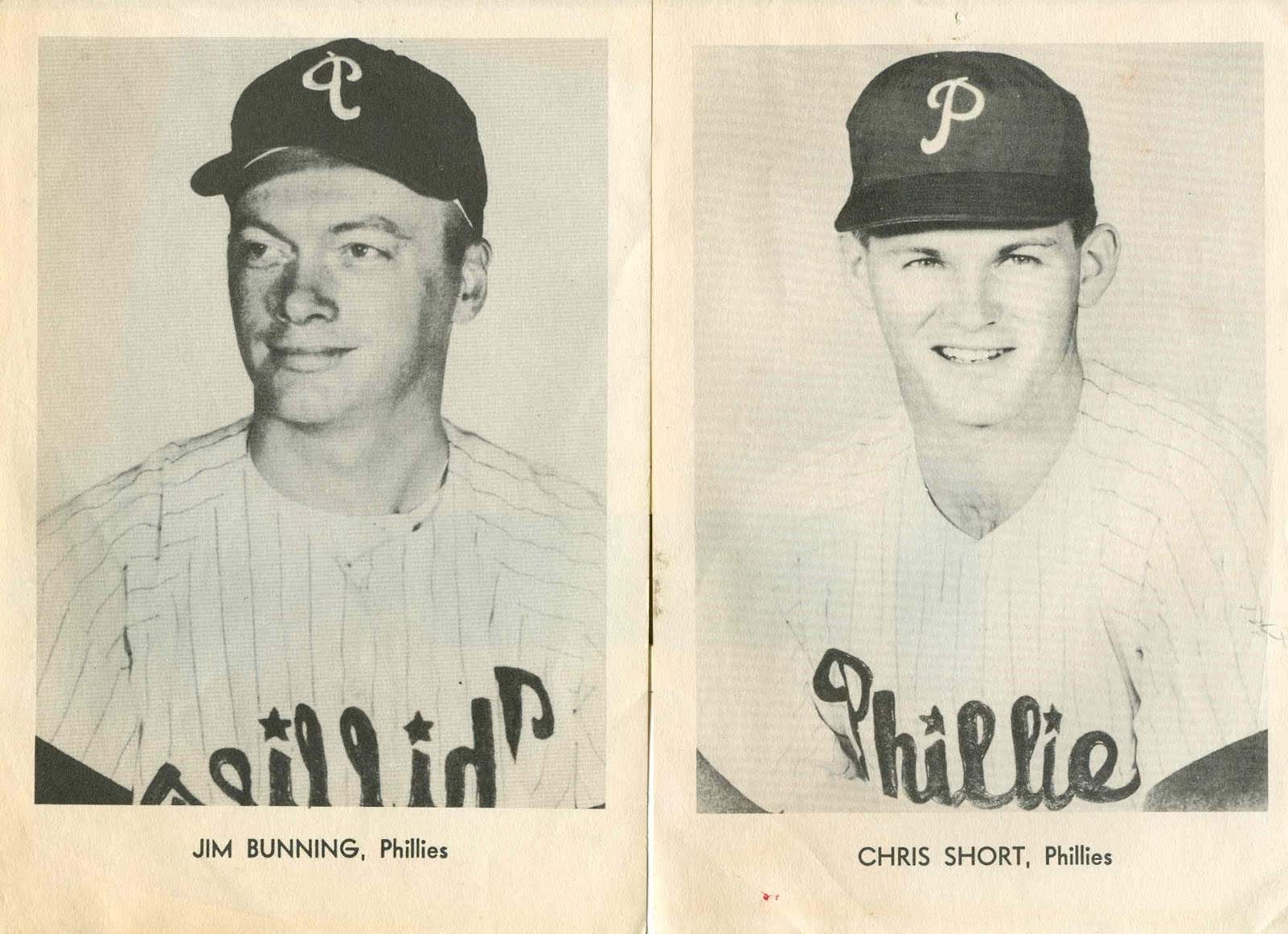
1967 Phillies Photos
I just found these in my house a few weeks ago. I bought them at the ballpark in 1967, and they have been in a folder in my desk since the 1970s (along with some old baseball card catalogs which I will be posting in the near future).
Here are 6 stars from the 1967 team. I don't know if these were the only ones issued, or if there were photos of all players, which you could collect in packs of 6. (Maybe Jim at The Phillies Room blog has these, or some more info about them.) Each photo is 5" x 7".


.
Monday, June 23, 2014
Jim Bunning Hall of Fame Poster
With all the recent hoopla about Jim Bunning's perfect game on Fathers' Day 50 years ago, I was reminded of a poster I picked up a few years ago.
I found this tonight, and remembered that I got it at a yard sale. They had a whole stack of them for sale, so I picked up one for me and one for my brother.
This poster is from 1996, when Bunning was inducted into the Hall of Fame.


The poster is 8 1/2" x 11", with a very high gloss on the front. Surrounding Bunning's portrait are all his Topps individual baseball cards from 1957 to 1971, plus the NL Strikeout Leaders card from the 1967 set. At the bottom is the ticket from the perfect game against the Mets in June 1964.
.
Tuesday, March 9, 2010
Trades: Jim Bunning to the Pirates (Dec. 1967)
Today I'm starting an occasional series about some of the trades in the mid-to-late 1960s involving big (or soon to be big) names. Trades like Frank Robinson to the Orioles, Fergie Jenkins to the Cubs, Lou Brock to the Cardinals, Frank Howard to the Senators, Dean Chance to the Twins, and Jim Bunning to the Pirates.

On December 15, 1967 the Phillies traded Jim Bunning, the ace of their staff, to the Pirates for pitcher Woodie Fryman and 3 minor-league prospects (shortstop Don Money, and pitchers Bill Laxton and Hal Clem). Bunning had been acquired from the Tigers 4 years earlier, and posted 19, 19, 19, and 17 wins in his 4 seasons with the Phillies. He was also among the strikeout leaders each season. I can remember thinking "What are the Phillies doing?!?"
(For good measure, on the same day the Phillies also traded pitcher Dick Ellsworth and veteran catcher Gene Oliver to the Red Sox for young defensive catching whiz Mike Ryan, but that's a story for another day.)
Who got the better of this deal? Let's look:
 Bunning was one of the top pitchers during the 1960s. In his first season in Philadelphia, he pitched a perfect game against the Mets in game 1 of a Fathers' Day doubleheader. (Rick Wise pitched the nitecap in his major-league debut.) He was the Phillies' ace during those 4 seasons.
After 2 non-descript seasons with the Pirates and Dodgers (with a combined record of 17-24), Bunning (although with diminished skills) was re-acquired by the Phillies. He closed out his career with the Phillies in 1970 and 1971, and was the opening-day starter in 1971, the Phillies' first game at Veterans Stadium. So, they didn't really lose much by Bunning's absence.
 Fryman's 1966 season earned him the Topps all-rookie award among southpaws. Woodie spent 4 1/2 seasons with the Phillies, initially as a starter, but in his later seasons he began making relief appearances. After leaving the Phillies, he went on to a long career with several teams, but he was a useful addition to the Phillies, and provided a steady lefthanded presence during the time when southpaw Chris Short's sore back acted up regularly.
 In the late-1960s, the Phillies were desperate for a shortstop. By 1967, Dick Groat had the mobility of a statue. Defensive specialist Bobby Wine couldn't hit a lick, and also developed a bad back, which eventually would keep him out of action for most of 1968. 1967 rookie Gary Sutherland proved to be not all that. Larry Bowa was still in the low minors, and hardly played at all in 1967.
Don Money had just played a combined 260 games for the Pirates' class-A teams in 1966 and 1967. He could be just what the doctor ordered! The Phillies rushed Money and rookie centerfielder Larry Hisle to the majors on opening day in 1968 but they both flopped. By the end of April they were both back in triple-A, but would be rookie stars in 1969. (That was a good break, because Wine, Sutherland, and 1968 fill-in shortstop Roberto Pena were all sent packing in the Fall 1968 expansion draft!) In 1970, Money slid over to 3rd base to make room for rookie Larry Bowa.
After 4 seasons with the Phillies, Don was traded to the Brewers for pitchers Jim Lonborg and Ken Brett. The Phillies needed to make room for rookie Mike Schmidt, Lonborg was a fine #2 starter behind Steve Carlton, and Brett pitched well for one season, then was swapped to the Pirates for 2nd baseman Dave Cash.
 Bill Laxton was drafted out of the Phillies' organization by the Padres in the 1970 rule 5 draft, and went on to have a spotty career with several teams.
 Hal Clem never made it above double-A.
Summary:
The Phillies swapped Bunning for Fryman (who had several good seasons in Philly) and Money (who helped solidify the Phillies' infield, then brought Jim Lonborg and Ken Brett (and by extension, Dave Cash) in return). On top of all that, they got Bunning back for 2 more seasons.
ADVANTAGE: Phillies
.
Subscribe to:
Posts (Atom)